


1. So You Want to Open a Restaurant in Canada?
A lot of people dream about opening their own restaurant. The idea of creating food people love, building a team & watching a dining room fill up every night is exciting. But before you sign a lease or buy a single pan, you need to know the real numbers.
Canada is a great market for food businesses. But it is also a competitive one. The costs of starting a restaurant here are significant & if you go in without a clear picture, things can get tough very quickly.
This guide focuses on the costs involved. If you are still in the early planning stage, our detailed guide on how to start a restaurant in Canada covers the full step by step process from concept to opening day. For now, let us talk numbers.
2. Average Restaurant Startup Costs in Canada
The average cost to open a restaurant in Canada falls somewhere between $150,000 & $800,000. That is a wide range & for good reason. A small breakfast cafe in a smaller city looks very different from a full service restaurant in downtown Toronto.
Here is a simple breakdown by restaurant type to give you a starting point:

If you are opening in Toronto or Vancouver, expect to add 20% to 40% on top of these numbers. Rent alone in those cities can be double what you would pay in a smaller market.
One thing to keep in mind: startup costs cover your one time expenses. Things like construction, equipment & deposits. Operating costs are the ongoing monthly bills. Both matter & both need to be in your plan.
“Most first time restaurant owners underestimate startup costs by at least 30%. Always build a contingency fund into your budget. Things always take longer & cost more than expected.” – David Mann, Restaurant Operations Consultant & Advisor
3. Full Startup Cost Breakdown
Here is every major cost category you will face when opening a restaurant in Canada.
a. Space & Construction
This is usually the biggest line item. Whether you are leasing an empty shell or taking over an existing space, there will be renovation costs.
- Lease deposit: usually 2 to 6 months of rent upfront
- Renovations & build out: $100 to $300 per square foot depending on the province & condition of the space
- Signage, lighting & dining room furniture
- Accessible washrooms & ventilation upgrades if required
Try to negotiate a leasehold improvement allowance from your landlord. This is money the landlord puts toward your build out in exchange for a longer lease. It can save you tens of thousands of dollars.
b. Kitchen Equipment
A commercial kitchen is expensive. There is no way around it. But there are ways to manage the cost.
- Commercial stoves, ovens & fryers
- Commercial refrigerators & freezers
- Dishwashers, prep tables & smallwares
- Ventilation hoods & fire suppression systems
Average kitchen equipment cost ranges from $50,000 to $150,000 or more for a full setup. Buying used or refurbished equipment from a certified supplier can cut this cost significantly. Look for NSF certified used equipment.
“A well planned kitchen saves money every single day. Spend time on your kitchen layout before you spend a dollar on equipment. Poor flow costs you in labour every service.” — Chef Mark McEwan, Award Winning Chef & Restaurateur, Toronto
c. Technology & Systems
Every restaurant needs a reliable point of sale system from day one. A good restaurant POS system handles your orders, payments, sales reports & inventory all in one place. Setup costs typically run $500 to $10,000 depending on the size of your operation.
Monthly subscription fees are an ongoing cost to factor in as well. See our full breakdown of restaurant POS costs in Canada to compare your options before committing.
- Reservation software & online ordering integration
- A QR code ordering system can reduce front of house labour costs & speed up table turnover once you are open
- Kitchen display system (KDS)
- Security cameras & Wi Fi setup
d. Opening Inventory & Food Stock
Before you open the doors you need product on the shelves. Plan for roughly 2 to 4 weeks of food & beverage inventory to start. This gives you a buffer while you figure out your actual usage patterns.
e. Working Capital Reserve
This one gets overlooked all the time. Most restaurants do not break even in the first 3 to 6 months. You need cash in the bank to cover your bills while the business builds momentum. Set aside at least 3 to 6 months of operating costs as a reserve.
f. Professional Fees
- Accountant: to set up your books & advise on structure
- Lawyer: for lease review & business registration
- Architect or interior designer: if doing a significant build out
g. Marketing & Branding
- Logo design & brand identity
- Website development
- Launch campaign (social media ads, Google ads, PR)
- Menu printing & photography
Do not skip this. Your brand is what brings people in before they ever taste your food.
4. Licenses, Permits & Legal Costs
In Canada, you need several approvals before you can legally operate a restaurant. Here is what to plan for:
- Business registration (federal & provincial): $100 to $500
- Food handler & safe food certification: required for you & your team
- Health department permit & food premises inspection fee: varies by municipality
- Occupancy & fire safety permits
- Music licensing through SOCAN & Re:Sound if you play music in your restaurant
Liquor License
If you want to serve alcohol, a liquor license is a major process & cost in Canada. Each province has its own body that handles this:
- Ontario: Alcohol & Gaming Commission of Ontario (AGCO)
- British Columbia: BC Liquor Distribution Branch (BCLDB)
- Other provinces have their own regulatory bodies
Liquor license costs typically range from $5,000 to $30,000 or more. The process can take several months so start early. If you are opening a bar & restaurant combo, expect additional seating requirements & compliance costs on top of this.
5. Restaurant Insurance Costs in Canada
Insurance is not optional. It protects your business, your team & your customers. Here is what you typically need:
- Commercial general liability insurance
- Commercial property insurance
- Product liability coverage
- Workers compensation (mandatory by province)
- Business interruption insurance
If you serve alcohol, you will need liquor liability insurance. Costs usually range from $300 to $1,200+ per month, depending on your size, location & coverage. Larger or licensed restaurants pay more than small cafes. You can reduce premiums by keeping a clean claims history, installing security & fire safety systems, & training your staff.
6. Ongoing Operating Costs & Monthly Expenses
Once you are open, the bills keep coming every month. Here is what makes up your typical monthly operating costs:
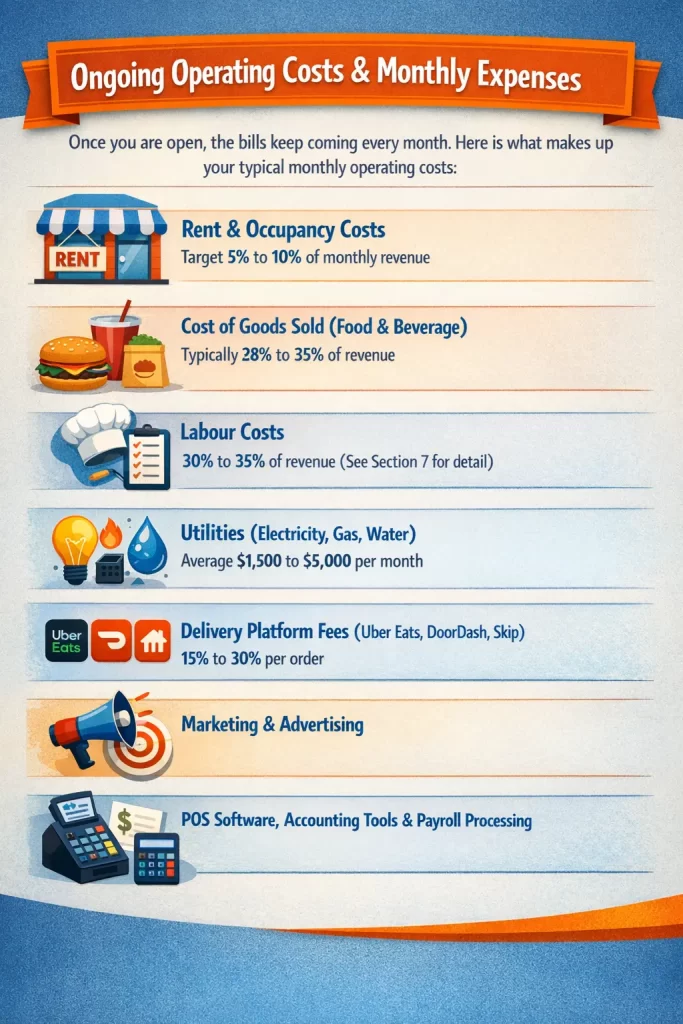
It helps to think about costs in two buckets. Fixed costs stay the same every month no matter how busy you are. Things like rent & insurance. Variable costs go up & down with your sales volume. Food & some labour costs fall into this category. Understanding the difference helps you manage cash flow.
7. Restaurant Labour Costs in Canada
Labour is almost always the biggest ongoing cost in a restaurant. Get this wrong & it does not matter how good your food is.
What the numbers should look like
- Total labour cost: 30% to 35% of total revenue
- Kitchen labour specifically: 18% to 22% of revenue
- Management & admin: included in the total labour budget
Minimum Wage by Province (2024 to 2025)
Minimum wage varies across Canada & is updated regularly. Some key examples:
- Ontario: $17.20 per hour
- British Columbia: $17.40 per hour
- Alberta: $15.00 per hour
- Quebec: $15.75 per hour
- Nova Scotia: $15.20 per hour
Always check the current rate for your province as these change regularly.
Other Labour Cost Factors
- Tipped staff may have a lower base wage in some provinces
- Statutory holiday pay is mandatory across all provinces
- Overtime rules vary by province but typically kick in after 44 hours per week in Ontario
- You must also factor in payroll taxes, CPP contributions & EI premiums
Smart scheduling is one of the best tools you have to control labour costs. Cross train staff so you can flex your team up & down with demand. Do not overstaff your opening weeks just because you are nervous.
To calculate your labour cost percentage, divide total labour dollars by total revenue & multiply by 100. If you did $50,000 in sales & spent $17,000 on labour, your labour cost is 34%. That is within range.
8. Cost Breakdown by Restaurant Type
Small or Independent Restaurant
Typical startup range: $150,000 to $350,000. The biggest cost variables are location, seating capacity & how complex your kitchen is. A 40 seat neighbourhood spot with a simple menu is much cheaper to open than a 70 seat restaurant with a full bar.
Fast Food or QSR
Startup range: $250,000 to $500,000 or more. If you are going with a franchise, add franchise fees which can range from $25,000 to $100,000 or more just for the right to use the brand. Corporate fit out requirements can also drive up your build out cost.
Breakfast & Brunch Restaurant
Startup range: $150,000 to $300,000. Lower evening overhead is a bonus but your morning rush creates real staffing intensity. Simpler menus often mean lower food cost percentages which helps your margins.
Cafe
Startup range: $80,000 to $250,000. Lower kitchen equipment costs compared to full service restaurants but you are very dependent on location & foot traffic. A good espresso machine alone can run $8,000 to $20,000.
Bar & Restaurant Combo
Startup range: $300,000 to $700,000 or more. The liquor license process is lengthy & expensive. You will also need to meet additional fire & occupancy codes. The upside is higher margin on alcohol sales when done right.
9. How to Reduce Your Startup & Operating Costs
You do not have to spend the maximum to open a great restaurant. Here are practical ways to keep costs under control:
On Startup Costs
- Buy used or refurbished kitchen equipment from NSF certified suppliers
- Lease equipment instead of buying outright to protect cash flow
- Negotiate a leasehold improvement allowance from your landlord
- Consider starting as a ghost kitchen or dark kitchen to validate your concept before doing a full build out
- Use freelancers for branding & design instead of big agencies
On Operating Costs
- Build your menu around high margin items & engineer it so they are the most visible
- Reduce your cost of sales by tightening portion control & minimising food waste
- Focus on growing your revenue alongside cutting costs. Our guide on how to increase restaurant sales covers proven strategies from upselling to loyalty programs that work in the Canadian market
- Use Google Business Profile & organic social to reduce customer acquisition costs before spending on ads
- Cross train staff so you need fewer people on shift during slower periods
Canadian Government Funding Options
There are real funding options available to Canadian restaurant startups:
- BDC (Business Development Bank of Canada): small business loans with flexible terms
- CDAP (Canadian Digital Adoption Program): grants for digital tools including POS & online ordering
- Provincial small business programs: vary by province but many offer grants & low interest loans for new businesses
10. Summary
Opening a restaurant in Canada is a real financial commitment. But with the right plan, the right numbers & a clear understanding of what it actually costs, it is absolutely doable.
Here is what to remember:
- Startup costs range from $80,000 for a small cafe to $700,000 or more for a full bar & restaurant
- Budget a working capital reserve of at least 3 to 6 months of operating costs
- Labour & food cost together should not exceed 65% of your revenue
- Get your licenses & permits sorted early. The liquor license process especially takes time
- Insurance is non negotiable. Get proper coverage from day one
- Use Canadian funding programs like BDC & CDAP to ease the financial pressure
The restaurants that succeed are the ones run by owners who know their numbers as well as they know their menu. Start with a solid financial plan & adjust as you learn.
11. Frequently Asked Questions
Q: What is the cheapest type of restaurant to open in Canada?
A cafe or small ghost kitchen is typically the most affordable entry point. A basic cafe can open for as little as $80,000. A ghost kitchen with no front of house can be even lower.
Q: How much does it cost to own vs. open a restaurant?
Opening a restaurant is the one time cost of getting started. Owning one means covering ongoing monthly operating costs which can range from $15,000 to $60,000 or more depending on your size & format.
Q: What should I budget for the first 6 months?
In addition to your startup costs, set aside at least 3 to 6 months of full operating costs as a cash reserve. Many restaurants do not break even in the first few months so having that buffer is critical.
Q: What is the most common reason restaurants fail financially?
Undercapitalisation is the number one culprit. Owners run out of cash before the business gains momentum. The second most common issue is high labour & food costs that eat into margins without the owner realising it until it is too late.