


Here is the short version: to legally run a food truck in Canada, you need a municipal business license, a food handler or health permit, a mobile food vending permit, a parking permit, commercial vehicle registration & insurance, & a fire safety permit if you cook with propane. First year costs generally run between $3,500 & $12,000+. Everything depends on which city & province you are in. A liquor license is optional & not available everywhere.
Let Me Walk You Through This
I have read a lot of questions from people wanting to start a food truck in Canada & honestly the number one thing that comes to my mind right away is: do you know what city you are planning to operate in? Because that changes everything.
The rules in Toronto are not the same as the rules in Vancouver or Calgary. So the very first thing you need to figure out is your location. Once you know that, the rest of the process becomes a lot more manageable.
A friend of mine launched her food truck in Mississauga a couple of years ago. She told me she wished someone had just given her a plain list of what she needed & in what order. So that is exactly what I am going to do here. I will cover all the licenses & permits, what they cost, how to apply, & the province by province differences.
Do You Actually Need a Permit or License for a Food Truck in Canada?
Yes. 100%. There is no way around it.
A lot of people think they can just buy a truck, cook some food, & park somewhere. But running a food truck means you are dealing with three levels of government at the same time: federal, provincial, & municipal. Each one has its own requirements.
Here is a quick look at what you are dealing with:
| Requirement | Who Issues It | Required? |
| Business License | Municipality | Yes |
| Food Handler & Health Permit | Provincial Health Authority | Yes |
| Vehicle & Commercial License | Provincial MTO / Registry | Yes |
| Parking & Vending Permit | Municipality | Yes |
| Liquor License | Provincial Liquor Board | Optional |
| Fire Safety Permit | Local Fire Department | Often Yes |
Now let me go through each of these one by one so you know exactly what you are getting into.
Here Are All the Licenses & Permits You Need
1. Business License
This is the very first thing you go after. Before anything else, you register your food truck as a business & get a municipal business license from your city or town office.
It usually costs somewhere between $100 & $500 per year & you renew it every year. Most cities now let you apply online through their business portal which makes it pretty painless.
“A business license is your foundation. Without it, everything else you build on top is legally shaky. Get that sorted before anything else.” — Mark Ellison, Small Business Advisor & Food Entrepreneur Coach, Toronto
2. Food Handler & Health Permit
This one is non-negotiable & it is the one that trips up a lot of new operators. Every province in Canada requires you to have food handler certification & pass a health inspection on your truck.
At least one person on your team needs to hold a valid Food Handler Certificate. Honestly, I would suggest getting everyone certified. It makes inspections go smoother & shows you are running a professional operation.
The health inspector will come to your truck. They check your fridge & freezer temps, your handwashing setup, how you store raw vs cooked food, & whether your equipment is up to standard. Once you pass you get your food safety permit.
Budget around $100 to $400 for the certification course & separate fees for the inspection itself. You renew this every one to two years depending on your province.
3. Vehicle & Commercial Driver License
Here is something a lot of first timers do not think about: your food truck is classified as a commercial vehicle in Canada. That means you need to register it as a commercial vehicle & get commercial vehicle insurance. Your personal auto policy will not cover you.
Now what license do you actually need to drive a food truck? For most standard sized trucks a Class G license is fine. But if you are running something heavier, like a converted bus or a large trailer setup, you might need a Class D or AZ license. Check with your provincial transportation ministry to be sure before you buy the truck.
4. Mobile Food Vending Permit
This is different from your business license. The mobile food vending permit is specifically what allows you to sell food from a mobile unit. Think of it as your permission slip to actually operate your truck on the street.
Some cities like Toronto & Vancouver only issue a limited number of these permits. So there is real competition. Apply as early as you can. Waiting too long is one of the most common mistakes new food truck owners make.
5. Parking & Location Permit
Even after you get your vending permit you still need to sort out where exactly you can park your truck. Want to operate on a public street? In a park? At a festival? You need a separate parking or location permit for all of that.
Some cities also have rules saying your truck has to be a certain distance away from restaurants & cafes. So scope out your preferred spots & check the rules before you commit to a location.
Costs here range from $100 to $1,500+ depending on the city & how long you need the permit.
6. Fire Safety & Propane Permit
If you are cooking with propane, gas, or anything involving open flame (which covers most food trucks), you need a fire safety permit. Your local fire department or safety authority handles this.
They will check your fire extinguisher, your suppression system above the cooking equipment, & how your propane setup is installed. Do not ignore this one. It is both a legal requirement & a genuine safety thing.
7. Liquor License (Only If You Need It)
Can you get a liquor license for a food truck in Canada? The short answer is: sometimes, in some provinces, with a lot of restrictions.
In Ontario you can look at Special Occasion Permits for specific events. In BC there are catering endorsements that might apply to your situation. But it is not straightforward & not every city allows it for mobile vendors at all. If this is something you want to offer, call your provincial liquor authority & ask directly before you plan around it.
8. Zoning & Land Use Approval
If you want to set up at the same spot regularly, like outside an office building or at a specific corner, you might also need zoning approval from your city planning department. This is especially common for private property arrangements. Worth checking before you sign anything with a property owner.
So How Much Does All This Actually Cost?
I know this is the part everyone really wants to know. The honest answer is: it depends a lot on your city. But here is a general breakdown to give you a realistic picture:
| License & Permit | Estimated Cost (CAD) |
| Business License | $100 to $500 / year |
| Food Handler Certificate | $100 to $300 per person |
| Health & Food Safety Permit | $200 to $500 / year |
| Mobile Vending Permit | $200 to $1,500 / year |
| Parking Permit | $100 to $1,500+ / year |
| Vehicle Registration & Insurance | $2,000 to $6,000+ / year |
| Fire Safety Inspection | $100 to $300 |
| Liquor License (if applicable) | $500 to $2,000+ |
| Estimated Total (Year 1) | $3,500 to $12,000+ |
Quick note: If you are operating in Toronto or Vancouver, expect to be on the higher end of these numbers. Bigger cities mean more competition for permits & higher municipal fees.
If you want to plan your full startup budget, I would suggest going through our detailed food truck cost guide for Canada. It covers the truck itself, equipment, permits, & everything in between so you have a complete picture before you commit.
How It Works Province by Province
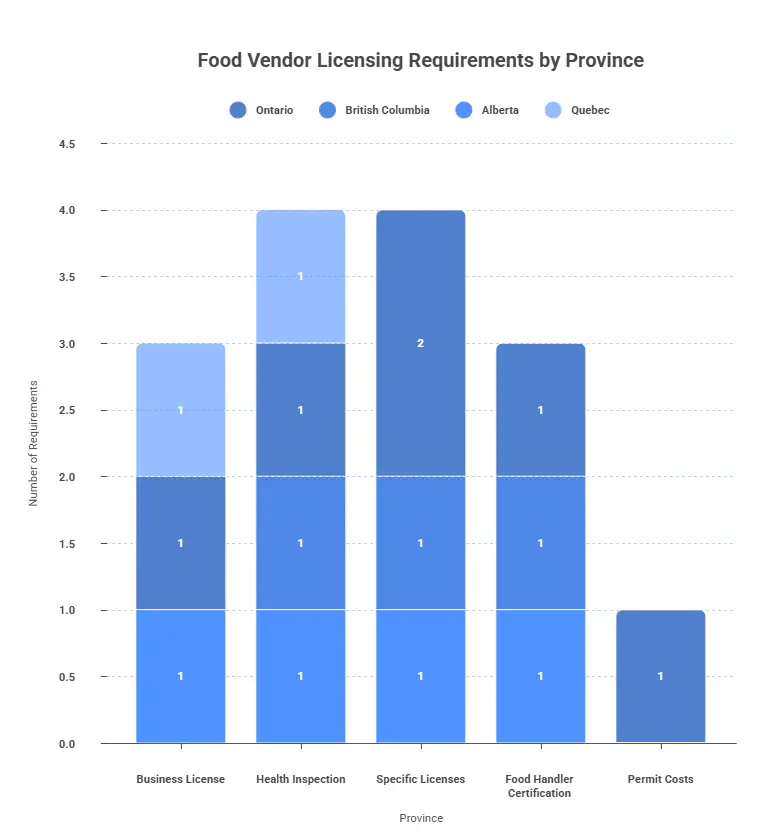
Let me give you the quick version for each major province since the rules are genuinely different depending on where you are.
Ontario
- Business license from your local municipality
- If you are in Toronto, you need to pass DineSafe inspection from Toronto Public Health
- Toronto operators also need a Refreshment Vehicle License specifically
- Food Handler Certification through a provincially recognized body
- Vending permit costs in Toronto can run $500 to $1,500+ per year
British Columbia
- Vancouver runs a Street Food Vending Program with limited spots & a competitive application process
- FoodSafe Level 1 certification is required
- Commercial vehicle permit through ICBC
- Vancouver uses a lottery system so you need a backup plan if you do not get selected right away
Alberta
- Calgary & Edmonton both have their own separate licensing programs
- You need a Public Health inspection & Food Handler certification
- Calgary specifically requires a Mobile Food Vendor Licence
Quebec
- You need a MAPAQ food establishment permit from the Ministere de l’Agriculture
- Standard municipal business license required
- All signage must be in French under Bill 101
Other Provinces
For Manitoba, Saskatchewan, Nova Scotia, New Brunswick, & the rest, the core requirements are pretty similar: business license, food handler cert, health inspection, & a vending permit. Check directly with your provincial health authority & your city office for the exact local rules.
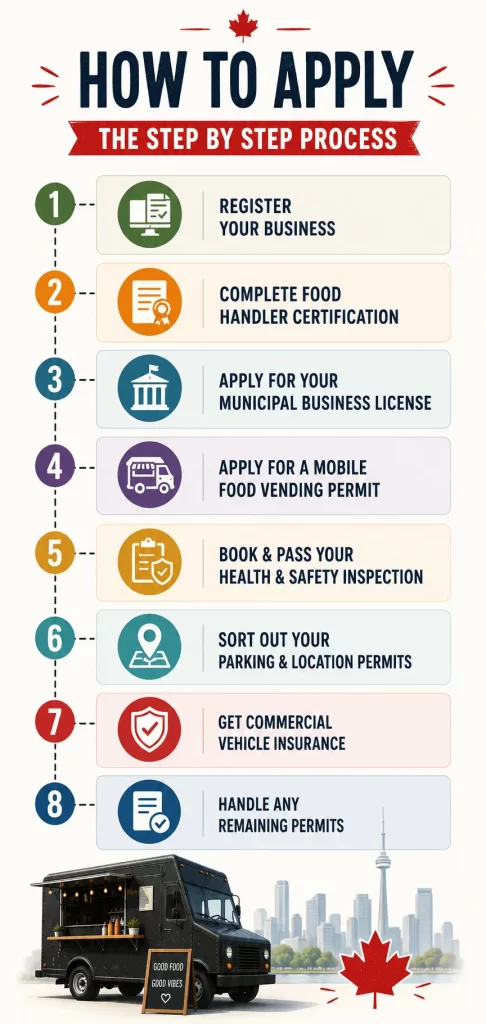
How to Apply: The Step by Step Process
Here is the order I would recommend going through this:
- Register Your Business: Pick your business structure (sole proprietorship, corporation, or partnership). Register your business name with the province & get yourself a CRA Business Number. This is your starting point for everything.
- Complete Food Handler Certification: Sign up for a recognized food safety course. ServSafe Canada works in most provinces. Ontario has its own certification program too. I really suggest getting your whole team certified, not just one person.
- Apply for Your Municipal Business License: Go to your city business licensing portal online. You will need your ID, your business registration documents, & proof of insurance ready.
- Apply for a Mobile Food Vending Permit: This is a separate application from the business license. You may need to submit vehicle inspection documents, your planned menu, & sometimes a commissary kitchen agreement.
- Book & Pass Your Health & Safety Inspection: Contact your local public health unit to schedule the inspection. Make sure your truck has a proper handwashing station, working refrigeration, & meets all the equipment standards before they show up.
- Sort Out Your Parking & Location Permits: Apply to your city for street vending approval or location specific permits. If you are planning to do events, talk to the organizers separately since they often have their own vendor permit process.
- Get Commercial Vehicle Insurance: Work with an insurance broker who actually has experience with food trucks. A regular auto insurance broker might not know the specifics you need.
- Handle Any Remaining Permits: Fire safety inspection, propane certification, & liquor licensing if that applies to your situation.

Once you are up & running, you will also want to think about how you take orders. A lot of food truck owners I have spoken to use a QR code ordering system so customers can browse the menu & pay from their phones. It cuts down lineups & speeds up service during busy hours.
Is It Actually Hard to Get a Food Truck License?
Honestly? It is not that hard. It is just a lot of steps & a lot of different offices to deal with. The biggest headaches I hear about are:
- Limited vending permits in competitive cities like Vancouver & Toronto where spots actually run out
- Juggling permits from multiple different government departments at the same time
- Keeping track of renewal dates so you do not accidentally let something lapse
A few things that actually help:
- Start 3 to 6 months before your launch date. This is not a one week process.
- Keep a simple permit tracker spreadsheet so nothing slips through the cracks
- If you are new to this, consider talking to a local food truck consultant or business advisor who knows your city
“The licensing process is not the hard part of running a food truck. It is just a checklist. The hard part is running a great business once you have all the boxes ticked.” — Lisa Tran, Food Truck Owner & Hospitality Entrepreneur, Montreal
Questions People Ask a Lot
Do I need a license to operate a food truck on private property?
Most of the time yes. Even on private property you typically still need a business license, a food permit, & zoning clearance from your city. Do not assume private property means no permit required. Always check first.
How much is a health permit for a food truck?
Generally between $200 & $500 per year. That is separate from the food handler certification cost which runs around $100 to $300 per person. Both are necessary.
Can I get a liquor license for a food truck?
In some provinces yes, but it is complicated. Ontario has Special Occasion Permits. BC has catering endorsements. But not every city allows it & the rules change. Call your provincial liquor authority directly & ask about mobile vendors specifically.
Do you need a permit to park a food truck?
Yes. Whether you are on a public street, in a park, or at an event, you need a parking or location permit. A lot of cities also have distance rules from restaurants so look those up for your specific spots.
What is the best way to manage orders on a food truck?
This is something a lot of new owners figure out too late. A proper restaurant POS system makes a huge difference for order management, payment processing, & tracking what is selling. Some food truck owners also set up a food ordering system so customers can pre-order before arriving. It really helps with rush periods.
How much does all this cost in total?
Plan for somewhere between $3,500 & $12,000+ in your first year just for licensing, permits, & vehicle registration. If you are in a major city, budget toward the higher end. If you want a full breakdown of startup costs, have a look at what a restaurant POS cost comparison looks like too since that is another expense worth planning for.
Final Thoughts
I have gone through this topic in a lot of detail because I know how confusing it can be when you are first starting out. The good news is that once you break it down into steps, it is really just a checklist.
Here is what you are working toward:
- Municipal business license
- Food handler certification & health permit
- Mobile food vending permit
- Parking & location permit
- Commercial vehicle registration & insurance
- Fire safety permit
- Liquor license if your province allows it & you want to offer alcohol
My suggestion is to start at least 3 to 6 months before your planned launch. Do not leave it until the last minute because some of these permits have wait times you cannot control.
Talk to your local city office early. Look up your provincial health authority website. & if you can, connect with other food truck owners in your city. Most of them are happy to share what the process looked like for them.
Good luck. The food truck world in Canada has a lot of room for people who are serious about doing it right.