


Quick Summary:
- A coffee cart costs about $10,000 to $50,000. A small cafe costs about $100,000 to $450,000. A full size coffee shop costs $300,000 or more.
- Most small cafes in Canada land near $220,000.
- Your biggest costs are renovation, equipment, & rent.
- Keep 3 to 6 months of running cash. Many new owners forget this part.
- You can save money with used equipment, a smaller menu, & a smaller space.
1. Introduction
I have read this question many times, & I have also talked to a few cafe owners about it. The very first thing that comes to my mind is this: what kind of coffee business do you want to open? Is it a small cart, a cozy cafe with ten seats, or a big shop with a full kitchen? You should choose wisely, because this one choice changes your cost the most.
So, how much do you need? The honest answer is “it depends.” I know that does not help much. So in this guide I will break down every cost in simple words, with real ranges in Canadian dollars.
One of my friends, Rohan, opened a small cafe in Calgary two years ago. He told me the same thing at the start: “I thought $80,000 was enough. I was wrong by almost double.” He was not careless. He just did not know what to ask. That is why I wrote this guide, mainly for first time owners in Canada.
If you want the full step by step plan after this, you can read our guide on how to start a cafe.
All numbers here are rough. Your final cost will change with your city & your choices. Always get real quotes before you sign anything.
2. Average Cost to Open a Coffee Shop in Canada
Let us start with the big picture. Here is what each type of coffee business usually costs in Canada.
| Format | Low | Mid | High |
| Coffee cart | $10,000 | $25,000 | $50,000 |
| Kiosk | $30,000 | $70,000 | $130,000 |
| Coffee truck or trailer | $50,000 | $100,000 | $180,000 |
| Small cafe | $100,000 | $220,000 | $450,000 |
| Full size coffee shop | $300,000 | $500,000 | $900,000 |
| Drive thru coffee shop | $450,000 | $800,000 | $1,500,000 |
Why is the range so wide?
When I first saw these numbers, I also felt confused. How can one cafe cost $100,000 & another cost $450,000? Here are the main reasons:
- Location. Rent in Toronto or Vancouver is much higher than in a small town.
- Size. More space means more rent, more furniture, & more equipment.
- Condition of the space. If the shop was a cafe before, you save a lot. If it is an empty unit with no plumbing, you will spend much more.
- New or used equipment. Used gear can save you thousands.
- Your menu. Coffee & pastries cost less than a full kitchen with hot food.
So think of these numbers as a starting point, not a final price.
3. Startup Cost Breakdown: Where the Money Goes
Now let us see where your money actually goes. This table is for a small cafe.
| Cost item | Low | Mid | High |
| Lease deposit & first months rent | $8,000 | $15,000 | $30,000 |
| Renovation & fit out | $30,000 | $70,000 | $150,000 |
| Espresso machine & grinders | $8,000 | $15,000 | $30,000 |
| Other equipment | $15,000 | $30,000 | $60,000 |
| Furniture, decor & signage | $8,000 | $18,000 | $35,000 |
| POS, QR ordering & tech | $2,000 | $5,000 | $10,000 |
| Licences, permits & insurance | $3,000 | $6,000 | $12,000 |
| Initial inventory | $4,000 | $8,000 | $15,000 |
| Pre opening marketing | $2,000 | $5,000 | $10,000 |
| Staff hiring, training & pre opening wages | $5,000 | $10,000 | $20,000 |
| Working capital (3 to 6 months) | $20,000 | $40,000 | $80,000 |
| Total | $105,000 | $222,000 | $452,000 |
Let me explain each one in simple words.
Lease deposit & first months rent
Most landlords ask for the first month, the last month, & a security deposit. Some also want a personal guarantee. Keep this cash ready before you sign.
Renovation & fit out
This is usually the biggest bill. It covers walls, floors, plumbing, electrical, the counter, a bathroom, & lighting.
If the space was a cafe before, you can save a lot. Also, ask the landlord about a “tenant allowance.” Some landlords help with the build cost, but only if you ask.
Espresso machine & grinders
Coffee is the heart of your cafe, so do not cheap out here. A good two group espresso machine costs $8,000 to $15,000 new. Each grinder costs $1,000 to $3,000. Top brands can cost much more.
Other equipment
You will also need fridges, a freezer, an oven or toaster, blenders, a dishwasher, a water filter, & a sink setup that meets health rules. If you serve hot food, this list grows fast. A kitchen hood alone can cost thousands.
Furniture, decor & signage
Chairs, tables, lights, wall art, & a good outdoor sign. You can start simple. A clean & warm room matters more than fancy decor.
POS, QR ordering & tech
You will need a Restaurant POS System to take orders, accept card payments, & track sales. Many cafes also add a QR code ordering system so guests can order from their phone & skip the line. Add Wi Fi, a tablet or two, & a ticket printer.
Licences, permits & insurance
This covers your business registration, health permits, & insurance. I have listed the details in Section 8.
Initial inventory
Beans, milk, syrups, cups, lids, pastries, & cleaning supplies. Start small. Order more when you learn what sells.
Pre opening marketing
A simple website, a Google Business Profile, social media, & a small opening event. Local marketing is cheap & works well for cafes.
Staff hiring, training & pre opening wages
You pay your team for a week or two before you open. They need to learn the menu, the machine, & the till. Please do not skip this. A rough first week can hurt your reviews.
Working capital (3 to 6 months of runway)
This is the cash that keeps you alive while sales grow. Most new cafes do not make a profit in month one. You still need to pay rent, wages, & suppliers.
"The biggest mistake I see is owners spending every dollar on the build & nothing on runway. A beautiful cafe with no cash left will close within a year."4. Cost by Province & City
Where you open matters a lot. Rent & wages are the two big differences.
| City | Rent level | Labour cost | Sales tax |
| Toronto, ON | Very high | High | 13% HST |
| Vancouver, BC | Very high | High | 5% GST + 7% PST |
| Calgary, AB | Medium | Medium | 5% GST |
| Montreal, QC | Medium to high | Medium | 5% GST + 9.975% QST |
| Ottawa, ON | Medium to high | Medium | 13% HST |
A few simple notes
- Calgary has no provincial sales tax, & rent is often lower than Toronto or Vancouver. That is one reason my friend Rohan chose it.
- Toronto & Vancouver have the highest rent. A prime street spot can eat your profit fast.
- Minimum wage is different in every province, & it goes up often. Check the current rate before you make your budget.
- Sales tax on food & drinks can be tricky. Talk to an accountant so you charge the right amount.
5. Lower Cost Ways to Start
You do not need a big cafe to start. Here are smaller ways in.
Small cafe (under 800 square feet). About $100,000 to $200,000. Rent is lower & you need fewer staff. The trade off is less seating, so you make less money per day.
Coffee stand or kiosk. About $30,000 to $130,000. Good for malls, offices, & train stations. The trade off is that you depend on the host location, & you may pay high rent or a share of sales.
Coffee cart. About $10,000 to $50,000. This is the cheapest way to begin. You can test your brand at markets & events. The trade off is weather, small space, & a short menu.
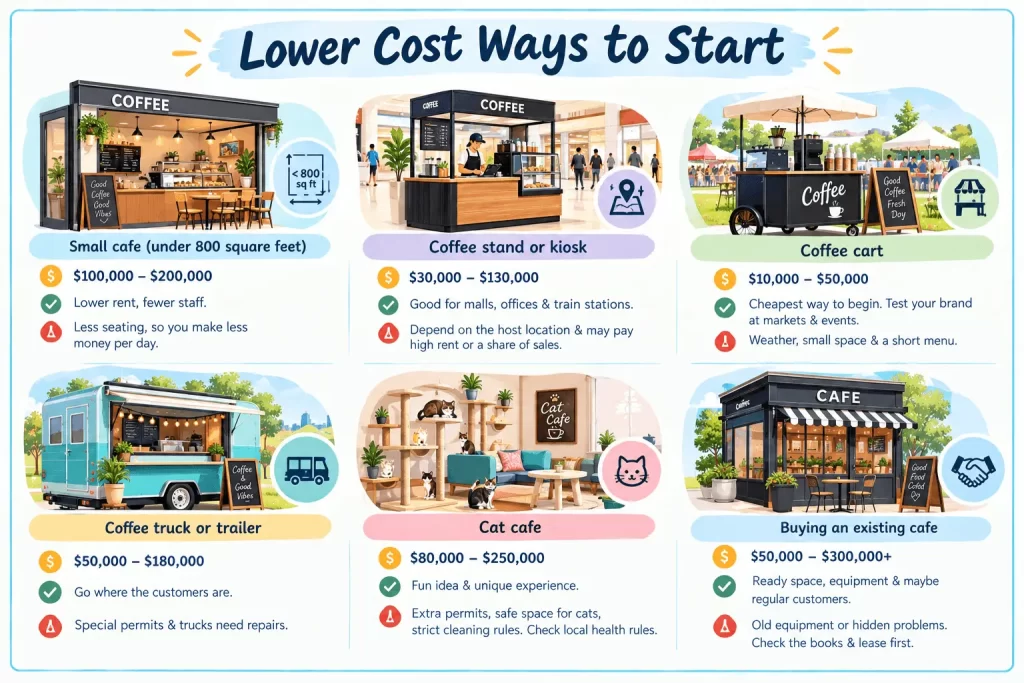
Coffee truck or trailer. About $50,000 to $180,000. You can go where the customers are. The trade off is special permits, & trucks need repairs.
Cat cafe. About $80,000 to $250,000. It is a fun idea, but you need extra permits, a safe space for the cats, & strict cleaning rules. Check local health rules first.
Buying an existing cafe. The price can go from $50,000 to $300,000 or more. You get a ready space, equipment, & maybe regular customers. The trade off is old equipment or hidden problems. Always check the books & the lease first.
6. Hidden & Ongoing Costs New Owners Miss
Opening day is not the finish line. The bills keep coming every month. Rohan told me this was the part that surprised him the most.
Here are the main monthly costs:
- Rent. Often your biggest fixed cost.
- Wages. Usually 25% to 35% of sales.
- Coffee beans, milk, & food. Usually 25% to 35% of sales.
- Utilities. Power, water, gas, internet, & garbage pickup.
- Card fees. Most card payments cost about 2% to 3% of each sale.
- Insurance. Liability, property, & maybe more.
- Software. POS, scheduling, & accounting tools. If you want to plan this part, read about restaurant POS system cost.
- Repairs & cleaning. Espresso machines need regular service.
Seasonality & slow first months
Cafes are not busy the same way all year. Summer can be slow near offices & schools. Winter can be slow for walk in guests in cold cities. Also, your first 3 to 6 months will be slow while people learn about you.
That is why working capital matters so much.
"Plan for sales to be half of what you expect in the first 3 months. If you can survive that, you can survive anything."7. How to Fund Your Cafe in Canada
Most owners do not pay for everything from savings. Here are common ways to fund a cafe.
- Personal savings. Lenders like to see that you put your own money in.
- Bank loans. Banks often ask for a business plan, a budget, & a personal guarantee.
- BDC (Business Development Bank of Canada). A lender that focuses on small businesses.
- Canada Small Business Financing Program. The government helps banks lend to small businesses. This can make it easier to get a loan for equipment or renovations.
- Equipment leasing. You pay a monthly fee instead of paying for the espresso machine up front.
- Partners or investors. You share ownership, but you also share the cash needs.
How much capital do lenders expect?
Many lenders like to see 20% to 30% of the total cost from your own money. So for a $200,000 cafe, you may need $40,000 to $60,000 of your own cash. Rules change by lender, so ask each one.
A small tip from me: keep a clear business plan, a menu, a budget, & a simple sales forecast ready. It makes a big difference.
8. Licences & Permits Cost Snapshot
Here are common licences & permits for a cafe in Canada. Costs change by city & province, so these are rough numbers.
| Item | Rough cost |
| Business registration | $60 to $400 |
| Municipal business licence | $100 to $500 |
| Health inspection or food premises permit | $100 to $600 |
| Food handler certificate | $15 to $150 per person |
| Signage permit | $100 to $500 |
| Music licence (SOCAN & Re:Sound) | A few hundred dollars per year |
| Liquor licence (if you serve alcohol) | $1,000 or more, & it varies a lot |
Check with your city office & provincial health authority before you plan your build. Health rules can change your layout, & that can change your cost.
9. Ways to Cut Costs Without Cutting Quality
You can save money & still run a great cafe. Here is how.
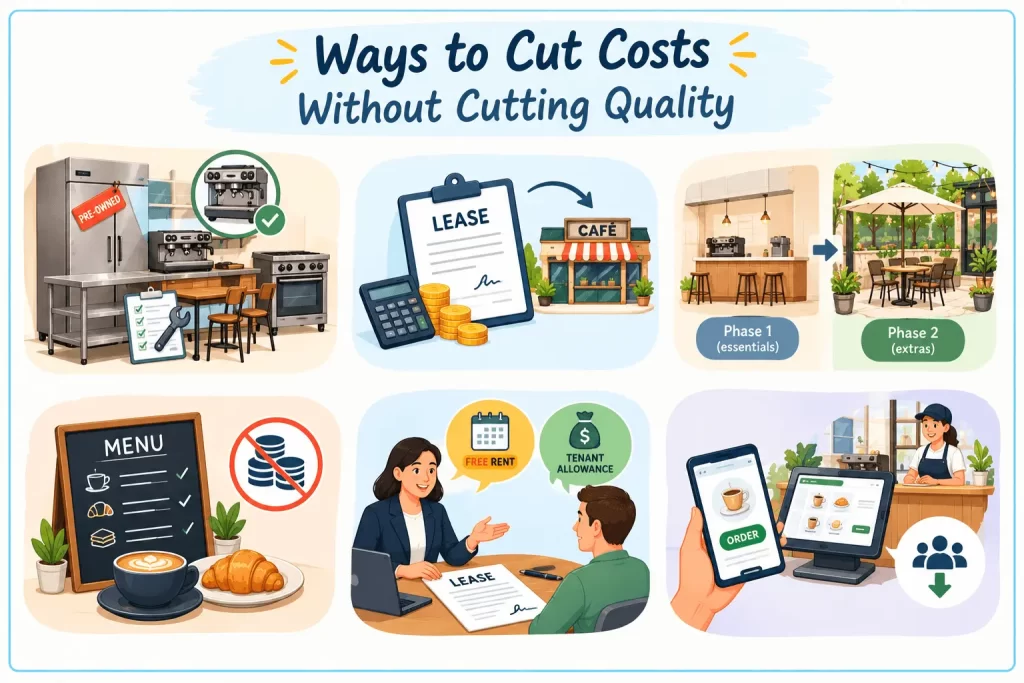
- Buy used equipment. Fridges, tables, chairs, & ovens are often fine second hand. Be careful with the espresso machine. Buy used only if it is serviced & tested.
- Lease instead of buy. Leasing big items keeps your cash free for the first few months.
- Phase your fit out. Open with the basics. Add extras like a patio when sales grow.
- Keep your menu small. Fewer items mean less waste, less stock, & less kitchen gear.
- Negotiate your lease. Ask for free rent during the build, or a tenant allowance.
- Use digital ordering. Pickup orders through a Food Ordering System & table ordering from phones can reduce the staff you need at the counter. That saves wages every month.
10. Quick Cost Checklist / Budget Template
Copy this list & fill in your own numbers.
My Cafe Startup Budget (CAD)
☐ Lease deposit & first months rent: $______
☐ Renovation & fit out: $______
☐ Espresso machine & grinders: $______
☐ Other equipment: $______
☐ Furniture, decor & signage: $______
☐ POS, QR ordering & tech: $______
☐ Licences, permits & insurance: $______
☐ Initial inventory: $______
☐ Pre opening marketing: $______
☐ Staff hiring & training: $______
☐ Working capital (3 to 6 months): $______
☐ Extra buffer (10% to 15%): $______
Total: $______
Always add a buffer of 10% to 15%. Something will cost more than you think.
11. FAQ
How much does it cost to open a small cafe in Canada?
Most small cafes cost between $100,000 & $450,000, & many land near $220,000. Your city, space, & equipment choices change the final number.
How much money do I need to start a coffee shop?
Plan for at least $100,000 for a small shop, plus 3 to 6 months of running cash. Lenders may also want you to put in 20% to 30% yourself.
Is a coffee shop profitable in Canada?
It can be, but margins are thin & depend on rent, wages, & steady customers. Good cost control & a strong location make a big difference.
What is the cheapest way to start a coffee business?
A coffee cart is the cheapest way in, often $10,000 to $50,000. It lets you test your brand before you spend on a full shop.
How much does a coffee cart or truck cost?
A cart costs about $10,000 to $50,000, & a coffee truck or trailer costs about $50,000 to $180,000. Permits & equipment can change the price.
How long before a new cafe breaks even?
Most cafes take about 6 to 18 months to break even. A cheaper setup & a good location can bring that time down.
12. Conclusion
So, how much does it cost to start a cafe or coffee shop in Canada? A coffee cart can start near $10,000. A small cafe usually costs $100,000 to $450,000. A full size shop can pass $500,000.
Your main costs are renovation, equipment, & rent. The cost people miss the most is working capital, so please do not forget the monthly bills after you open.
My advice is simple. First decide what kind of cafe you want. Then make a budget, get real quotes, & add a buffer. After that, talk to a lender or an accountant with your numbers ready.
A good plan will not make opening a cafe free, but it will make it a lot less scary.