


| I get this question a lot, so here is the short version. Opening a cafe in Canada is still worth it if you plan it well. You will need a business plan, the right license for your province & city, a good spot, basic gear like an espresso machine & a dependable point of sale system, & enough cash to cover the first few slow months. A small kiosk or cart can start around 50000 dollars. A full sit down cafe often runs 200000 dollars or more. Most owners begin small, sort out permits early, & grow one step at a time. |
1. Is Opening a Cafe in Canada Actually Worth It?
I have seen this question a lot lately, so I dug into it properly before writing this. The very first thing that comes to my mind is what you are actually picturing, a small neighbourhood counter or a bigger sit down space, because that changes almost every answer below. So think about that first & pick what fits your budget & your life.
Coffee is one of those things people do not give up, even when money is tight. Canadians drink a lot of coffee & most of them have a cafe they go back to again & again. That part is good news for you. The other side, honestly, is that running a cafe is real work. My friend Arjun opened a small cafe in Mississauga two years back & he still tells me the early mornings never really get easier, you just get used to them.
Even so, cafes remain a strong small business bet for a few plain reasons. Cafe startup cost can be lower than a full restaurant. You do not need a huge menu to do well. A loyal neighbourhood crowd can carry a small cafe for years. If you pick a good spot, keep your menu simple, & watch your costs closely, a cafe can turn into a steady income & sometimes a real growth business, the way Arjun grew from one small counter to two locations.
A cafe does not need to be big to be profitable, it needs to be consistent. Owners who nail the same cup, the same feel, & the same service every single day are the ones who last past year one. Priya Nair, Independent Cafe Consultant, Toronto
2. Cafe Rules Are Different Across Canada: Ontario & Toronto Basics
This is the part that trips up almost everyone I talk to, myself included when I first looked into it. Canada does not have one single set of rules for opening a cafe. Food business rules come from three levels, federal, provincial, & municipal. Your city or town often has its own extra steps on top of the province. I am only giving you the general picture here, not legal advice, so please check with your own local city office & your provincial health authority before you sign anything.
Province vs Municipal Licensing
From what I found & from what Arjun went through himself, your province sets the base food safety rules & usually the food handler certificate rules. Your city or municipality handles zoning, business licensing, signage rules, & fire inspections. So a cafe in Toronto & a cafe in a small Ontario town can face different paperwork even though both are in Ontario.
Ontario & Toronto Specific Notes
- Health inspections: Toronto Public Health & Ontario health units inspect food premises before you open & keep checking after, so your kitchen layout & food handling plan need to be ready early.
- Zoning: Not every commercial space is zoned for food service, so confirm zoning with the city before you sign a lease.
- Business registration: You will usually register your business name with the province, then apply for a municipal business license, a food premises license, & often a sign permit.
Rules can change, so please treat this as a starting checklist & confirm every single item with your local city office before you spend money on a space.
3. What You Actually Need to Open a Cafe
Once the paperwork side is somewhat clear in your head, here is what you actually need on the ground to open the doors. I am basing this partly on my own reading & partly on what Arjun set up when he first started.
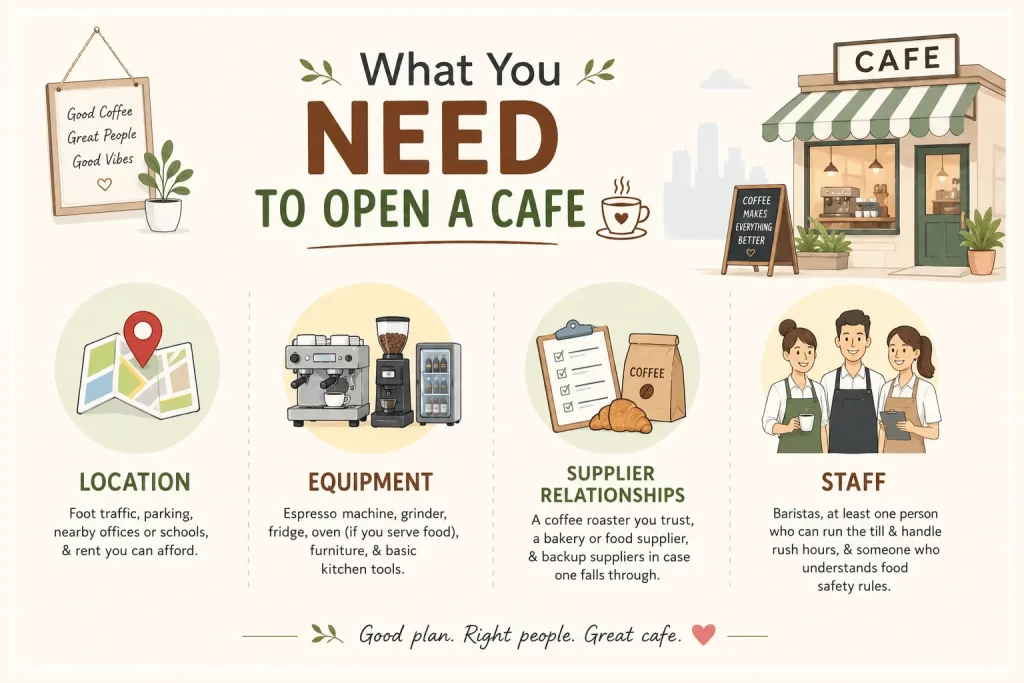
- Location: foot traffic, parking, nearby offices or schools, & rent you can actually afford
- Equipment: espresso machine, grinder, fridge, oven if you serve food, furniture, & basic kitchen tools
- Supplier relationships: a coffee roaster you trust, a bakery or food supplier, & backup suppliers in case one falls through
- Staff: baristas, at least one person who can run the till & handle rush hours, & someone who understands food safety rules
You also need a smooth way to take orders & payments. Arjun struggled with this in his first few months because he was tracking everything by hand, then he moved to a simple point of sale system that handles orders, payments, & sales reports in one place, so he was no longer guessing at his numbers at the end of the week.
Getting these basics sorted before opening day saves you from scrambling through your first busy week the way Arjun did.
4. Opening a Cafe on a Low Budget or With No Money
A lot of people ask me how to open a cafe with no money, but the honest answer, based on everyone I have spoken to, is that you almost always need some money. What you can actually do is open with less money than you think. There is a real difference between no money & less money than a full sit down cafe would need, & I think that difference is worth sitting with for a minute.
Small Format Alternatives
A coffee cart, a small kiosk, or a pop up stand can cost a fraction of a full cafe build. These formats let you test your coffee, your brand, & your local demand before you commit to a big lease. One of my cousins started with a single coffee cart at a Vancouver farmers market before she ever signed a lease for a real shop, & she says that small start taught her more than any business course could have.
Financing Options in Canada
- Small business loans from banks or credit unions, often easier to get with a clear business plan
- Government backed small business loan programs that support new Canadian businesses
- Local & regional small business grants, which change often so check your province & city website
- Partnerships, where a partner brings in capital while you bring in the daily running of the cafe
New owners always ask me how to open with less cash. My honest advice is start smaller than you want to. A cart or a small kiosk that proves the idea works is worth more than a big loan for a cafe that has never been tested.
Daniel Ferreira, Small Business Advisor, Ontario
5. Step by Step: From Idea to Opening Day
Here is the order I would follow myself, based on what worked for Arjun & what my cousin wishes she had known earlier.
- Write a simple business plan covering your menu, your target customer, & your rough budget
- Register your business name with your province
- Apply for your food premises license & any municipal business license you need
- Pick & confirm your location, including zoning approval
- Build out the space, including kitchen setup, furniture, & signage
- Set up your suppliers, your point of sale, & your basic accounting
- Hire & train your staff on the menu, food safety, & customer service
- Run a soft launch with a smaller crowd before your full public opening
Working through these steps in order keeps you from paying for a build out before you even know your zoning is approved, which is exactly the kind of expensive mistake I have heard about more than once.
6. Cafe, Cart, Truck, or Drive Thru: Picking Your Format
Not every cafe needs four walls & a full dining room, & honestly I think this is the part people overthink the most. Picking the right format changes your startup cost, how mobile your business is, & even which rules apply to you.
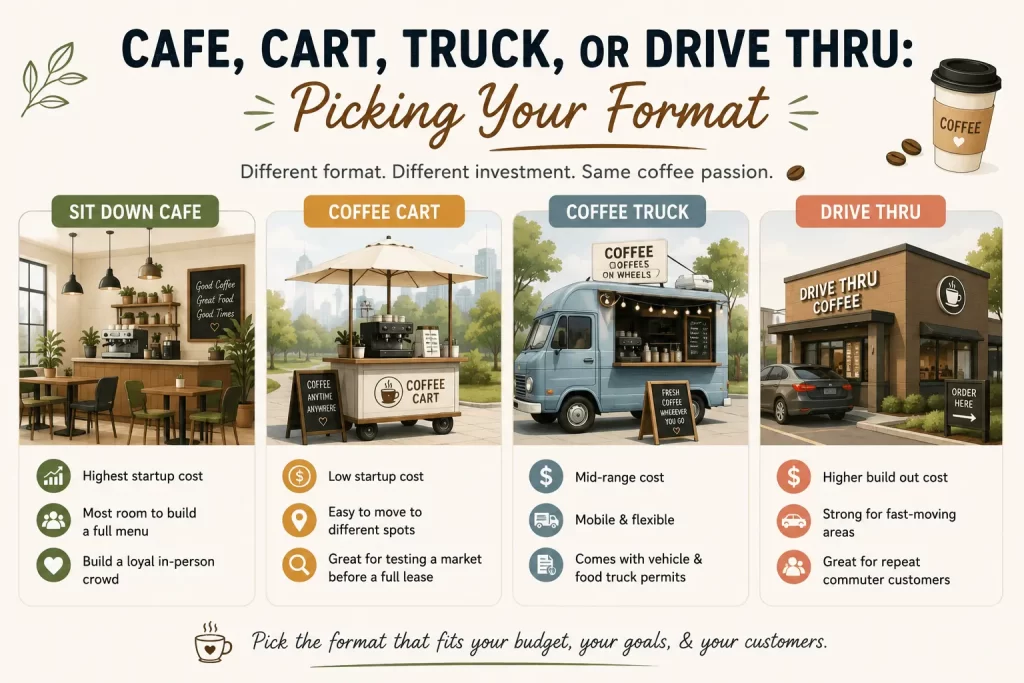
- Sit down cafe: highest startup cost, but the most room to build a full menu & a loyal in person crowd
- Coffee cart: low startup cost, easy to move to different spots, good for testing a market before a full lease
- Coffee truck: mid range cost, mobile, but comes with its own vehicle & food truck permits
- Drive thru: higher build out cost but strong for fast moving areas & repeat commuter customers
For a true beginner with limited savings, my honest suggestion, based on what my cousin did, is a cart or a small kiosk. It keeps your risk low while you learn how to run a coffee business day to day.
My cousin also added a simple QR code ordering system at her cart window so customers could order & pay right from their phone, & she says it cut her line time down a lot during her busiest weekend mornings.
7. Common Mistakes First Time Cafe Owners Make
I asked around a bit while researching this, & the same few mistakes kept coming up again & again, both from Arjun & from people he knows in the business.
- Underestimating costs, especially rent, renovation, & the first few slow months before regular customers build up
- Weak location scouting, picking a pretty spot without checking real foot traffic or nearby competition
- No clear menu focus, trying to offer too many items instead of doing a few things really well
- Poor staff training, which shows up fast in slow service & inconsistent drinks
Almost every cafe that struggles in year one has the same root problem, they spent too much on the space & too little time on training staff & testing the menu before opening. Sarah Whitfield, Restaurant & Cafe Operations Coach
Avoiding these mistakes will not guarantee success, but it removes a lot of the risk that first time owners face without even realising it, at least that has been my honest takeaway from talking to people who have actually done this.
8. FAQ
A few questions come up every single time I discuss this topic, so let me answer them here directly.
How much does it cost to open a small cafe in Canada?
A small cart or kiosk can start around 50000 dollars, while a full sit down cafe often runs 200000 dollars or more once you add rent deposits, renovation, equipment, & the first few months of operating costs.
Can I open a coffee shop with no experience?
Yes, many owners start with no direct cafe experience, Arjun included. What matters more is a clear business plan, a willingness to learn food safety & service basics, & hiring at least one experienced person to help guide daily operations early on.
Do I need a business license to open a cafe in Ontario?
Yes, in most cases you will need to register your business name with the province & apply for a municipal business license along with a food premises license from your local health unit before you can legally open.
9. Final Thoughts
Starting a cafe in Canada is not simple, but from everything I have read & from watching Arjun & my cousin go through it themselves, it is very doable if you take it step by step. Get your licensing sorted early, pick a format that matches your budget, keep your menu focused, & put real effort into training your team. Do that & your cafe has a real shot at becoming the kind of place people come back to every single week, the same way people keep going back to Arjun & my cousin.