


Quick Answer
Here is what you need to know upfront:
✓ Yes, you need multiple licences & permits to legally open a restaurant in Canada.
✓ The exact list varies by province & municipality but the core ones are: business licence, food premises permit, health inspection, fire safety permit & a liquor licence if you plan to serve alcohol.
✓ Total cost in year one ranges from around $500 to $5,000+ depending on your location & the licences you need.
✓ Some permits like the liquor licence can take 8 to 16 weeks or longer so start early.
✓ This guide walks you through every licence, every cost & exactly how to apply.
Opening a restaurant in Canada is exciting. You have your menu planned, your space picked out & your launch date in mind. But before you open the doors, there is one part of the process that catches a lot of new operators off guard: the paperwork.
Getting the right licences & permits is not optional. It is the legal foundation your restaurant runs on. If you skip it or get it wrong, you could face fines, forced closure or issues with your insurance. The good news? Once you know what you need, the process is manageable.
Every province & municipality in Canada has its own set of rules, so there is no single answer that fits every restaurant. But this guide gives you a clear picture of what is typically required, what it costs & how to get started. Whether you are planning a full dine-in restaurant, a cafe or something more unique like a ghost kitchen, this is the guide you need.
1. Why Do Licences & Permits Matter?
Some people assume that as long as the food is good & the space looks nice, they are ready to go. But legally, you need to be licensed before you even flip the sign to open.
Here is why it matters:
- Licences protect your customers. Food safety rules, fire exits & liquor compliance all exist to keep people safe.
- They protect you as a business owner. If something goes wrong & you are not properly licensed, your liability exposure is enormous.
- Banks & landlords want to see your permits. Many lenders will not approve a business loan without proof you are licensed. Some landlords require it before signing a lease too.
- Inspectors do show up. Health inspectors, fire safety officers & municipal bylaw officers can visit at any time. Non-compliance has real consequences.
The requirements are a bit different for restaurants, cafes, food trucks & pop-up formats. We cover the special cases later in this guide. If you are just starting out, you might also want to read our guide on how to start or open a restaurant for a broader look at what the whole process involves.
2. Complete List of Licences & Permits You Need
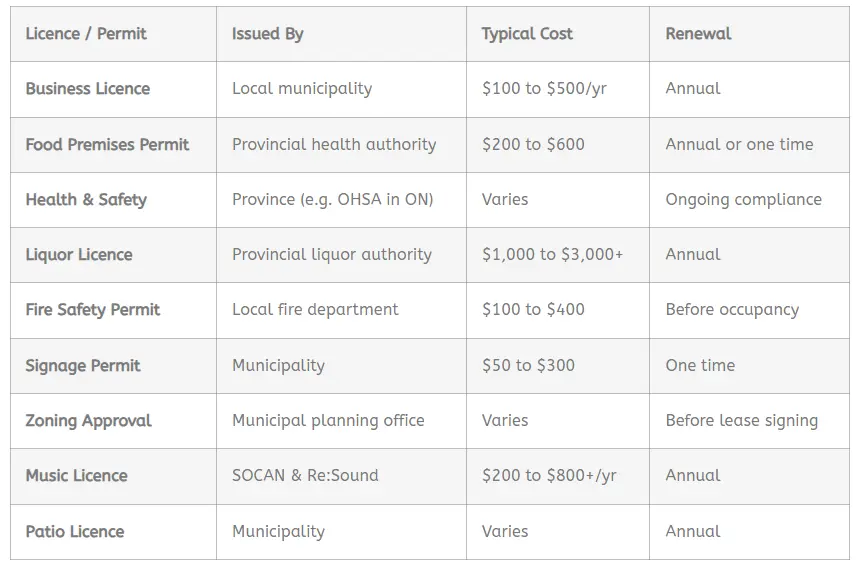
Most Canadian restaurants need the following licences. Not every one applies to every business but this list covers the ones that come up most often.
2.1 Business Licence
This one is required everywhere in Canada. You get it from your local municipality before you can legally run any business. The cost & how often you renew it varies by city but most fall in the $100 to $500 per year range.
2.2 Food Premises Permit
This comes from your provincial or regional public health authority. Your premises gets a health inspection before you open & all staff who handle food typically need a Food Safe Level 1 certificate or the provincial equivalent.
2.3 Health & Safety Permit
Workplace health & safety compliance is required in every province. In Ontario it falls under the Occupational Health & Safety Act. Some provinces require a formal permit while others just require you to follow the rules & be ready for an inspection.
2.4 Liquor Licence
If you plan to serve or sell alcohol, this is the big one. Each province has its own liquor authority. In Ontario it is the AGCO. In BC it is the LCRB. In Alberta it is the AGLC. This is usually the most time-consuming licence to get & we cover the full process in Section 4.
"The liquor licence is the one that trips most people up. It takes longer than expected & the requirements vary a lot by province. My advice is always to start that application the moment you sign your lease, not the week before opening." — Marcus Tran, Restaurant & Hospitality Consultant, Vancouver BC2.5 Fire Safety & Building Permit
Your local fire department & municipal building authority issue these. They cover things like fire exits, sprinklers, suppression systems & maximum occupancy. These are usually required before you begin any fit-out work so do not leave them until the last minute.
2.6 Signage Permit
Most municipalities require a permit for exterior signage. Rules vary depending on your zoning classification & whether the building has any heritage designations.
2.7 Zoning or Land Use Approval
Before you sign a lease, confirm your location is actually zoned for restaurant use. Zoning rules can also affect your operating hours, whether you can have outdoor seating & whether drive-throughs are allowed. Check with your local planning office before committing.
2.8 Music Licence
If you plan to play background music, even from a streaming service, you need a licence. This is covered in detail in Section 5.
2.9 Patio Licence
If you want outdoor seating, most Canadian cities require a separate patio licence from the municipality. If your patio is licensed for alcohol, you may also need a separate liquor endorsement for that space.
3. How Much Do Restaurant Licences Cost in Canada?
This is one of the first questions operators ask & the honest answer is: it depends. Your location, your licence types & your province all affect the final number. But here is a realistic range to help you budget.
| Licence Type | Typical Cost Range | Notes |
| Business Licence | $100 to $500 per year | Varies by city & municipality |
| Food Premises Permit | $200 to $600 | One time or annual depending on province |
| Liquor Licence | $1,000 to $3,000+ | Application fee plus annual renewal |
| Fire Safety Permit | $100 to $400 | Required before occupancy |
| Signage Permit | $50 to $300 | Varies by zoning rules |
| Music Licence (SOCAN) | $200 to $800+ per year | Based on venue size & music type |
| Re:Sound Licence | 26.8% of SOCAN fees | Required alongside SOCAN |
| Total (Year One) | $500 to $5,000+ | Depends on province, city & licence types needed |
A few province-specific notes worth knowing:
- Ontario: Liquor licence application fees through the AGCO can run $1,000 to $2,000 just for the initial application, with annual renewal on top.
- British Columbia: Food premises permit fees vary by health authority. The LCRB charges separately for each endorsement on your liquor licence.
- Quebec: The RACJ has a tiered fee structure based on capacity. Food handler certification via MAPAQ has its own training & exam cost.
These numbers change regularly so always check directly with your provincial authority or municipal office for the most current fees. Understanding the cost to start or open a restaurant is something you need to budget for early, and permits are a significant part of that.
"A lot of first time restaurant owners budget for the fit-out & the equipment but forget to factor in permit costs. Depending on the city & the type of licence you need, you could be looking at $3,000 to $5,000 in fees before you even switch the lights on. Build it into your opening budget from day one." — Priya Mehta, Hospitality Business Advisor, Toronto ON
4. How to Apply for a Restaurant Licence in Canada
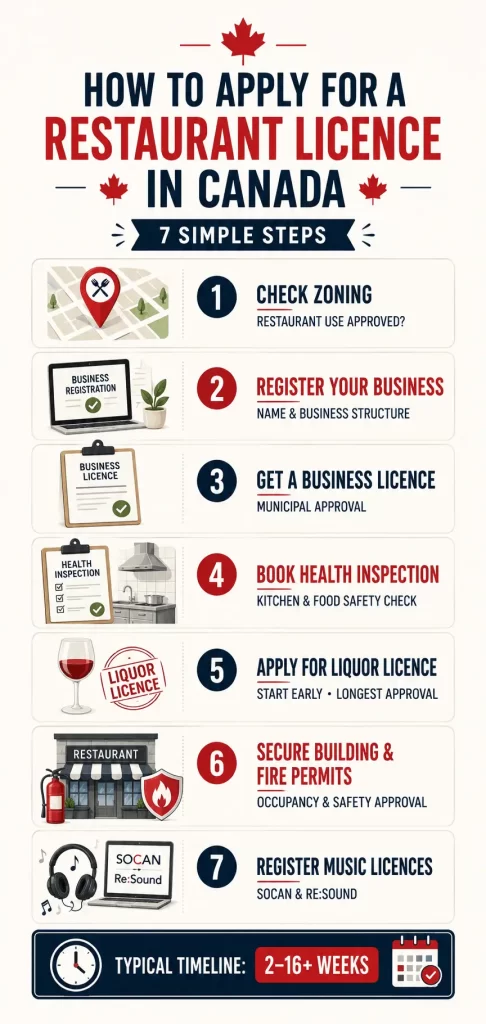
The application process looks different depending on which licence you are applying for. Here is a practical step by step guide to getting through it.
Step 1 — Confirm your zoning
Before you apply for anything, check that your location is zoned for restaurant use. Contact your local planning & development office or look up the municipal zoning map online. This step can save you from signing a lease on a space that does not legally permit food service.
Step 2 — Register your business
Register your business name with your provincial registry. In Ontario that is ServiceOntario. In BC it is BC Registries. You also need to choose your business structure: sole trader, partnership or corporation. This is usually the first formal step.
Step 3 — Apply for your business licence
Submit your application to the local municipal office or through the city online portal. You typically need proof of address, your business registration & sometimes proof of insurance.
Step 4 — Schedule your health inspection
Get in touch with your local public health unit to arrange a pre-opening inspection. They will assess your kitchen layout, food storage setup & handling processes. Book this early because inspector availability varies by region.
Step 5 — Apply for your liquor licence
If you are serving alcohol, submit your application to the provincial liquor authority as early as possible. This is the slowest part of the process. In Ontario it is the AGCO. In BC it is the LCRB. In Alberta it is the AGLC. In Quebec it is the RACJ. Expect a minimum of 8 to 12 weeks & often longer.
Step 6 — Get fire safety & building permits
Engage your local fire department & building authority before your fit-out begins. You will need occupancy approval before you can open. These take 2 to 8 weeks depending on the scope of your build.
Step 7 — Register for music licensing
If you plan to play background music, register with SOCAN & Re:Sound online. Both are straightforward to set up. See Section 5 for the full details on cost & what is required.
Once all your licences are in place, setting up your operations is the next big task. A reliable food ordering system makes a huge difference when you are ready to start taking orders from day one.
5. Music Licensing for Restaurants in Canada
This one surprises a lot of restaurant owners. If you play music in your venue, even a Spotify playlist through a Bluetooth speaker, you legally need a music licence. A personal streaming subscription only covers private listening, not public performance in a commercial space.
Who Issues Music Licences in Canada?
There are two organisations you need to know:
- SOCAN (Society of Composers, Authors & Music Publishers of Canada) covers the performance rights for songwriters & publishers.
- Re:Sound covers the rights of recording artists & record labels.
Most restaurants need both. You can register for both online & the process is quick.
How Much Does a Restaurant Music Licence Cost?
Fees are based on factors like your venue size, whether you have a DJ or live entertainment & whether you serve alcohol. General ranges:
- SOCAN: roughly $200 to $800+ per year for a small to mid-size restaurant
- Re:Sound: fees are calculated at 26.8% of your SOCAN fees
Always check the current tariff schedules on the SOCAN & Re:Sound websites directly as fees are updated regularly.
6. Do You Need a Chef Licence to Open a Restaurant?
Short answer: no. There is no legal requirement in Canada to hold a chef qualification or culinary certificate to open or operate a restaurant. Anyone can legally cook commercially without a formal culinary degree.
What you do need is food safety certification for anyone handling food. Whether that is you as the owner, your head chef or a kitchen hand, everyone needs a valid certificate like Food Safe Level 1 in BC, Food Handler Certification in Ontario or the provincial equivalent where you operate.
Hiring trained chefs is a smart business move for consistency & quality, but it is not something the government requires you to do to get your licence.
7. Licensed vs Unlicensed Restaurant: What is the Difference?
If you have ever seen a listing that says ‘fully licensed’ or looked up a restaurant that described itself as BYO, here is what those terms actually mean.
What Does Fully Licensed Mean?
A fully licensed restaurant holds a liquor licence from the provincial liquor authority. This gives the venue the legal right to sell & serve alcoholic beverages including beer, wine & spirits. The licence typically covers the dining room, the bar & any licensed patio space.
What is an Unlicensed Restaurant?
An unlicensed restaurant is permitted to serve food but cannot sell alcohol. In some provinces, customers are allowed to bring their own alcohol under a BYO arrangement, but this requires a separate endorsement & the rules vary by province.
Why Does It Matter for Your Business?
Your licensing status directly affects your revenue potential. Alcohol sales tend to have high margins & contribute significantly to a restaurant’s income. It also affects your lease negotiations, your insurance & even how you appear on platforms like Google & Yelp. Many landlords in prime locations prefer or require a liquor licence as part of the tenancy.
"A liquor licence is not just a permit. It is a revenue strategy. For most casual dining restaurants, alcohol sales make up 20 to 35 percent of total revenue. If you are eligible for a licence, get one. The application cost pays itself back fast." — Jennifer Osei, Restaurant Operations Specialist, Calgary AB
8. Pop-Up Restaurants, Food Trucks & Ghost Kitchens
Not every food business is a traditional dine-in restaurant. Here is what you need to know if your format is a bit different.
Pop-Up Restaurants
Yes, you still need permits for a pop-up, even if you are only running for a weekend. A temporary food premises permit is typically required along with a business licence. If alcohol is involved, you may need an event-specific liquor permit. Requirements vary by municipality so check with local authorities well in advance.
Food Trucks
Food trucks require a business licence, a food handler permit, a vehicle permit & a location-specific permit for each pitch or zone you operate in. Many cities have dedicated food truck bylaws & approved zones. For a full breakdown of what is involved, our guide on licences & permits needed for a food truck goes into the specifics.
Ghost Kitchens
Ghost kitchens or dark kitchens still need a food premises permit & business licence even though they have no dine-in customers. Health inspections apply the same way as for a traditional kitchen. If you are running a delivery-first business, make sure your kitchen setup meets the health authority requirements for your province.
9. How Long Does It Take to Get a Restaurant Licence?
Timeline varies by permit type & province. Here is a general guide:
- Business Licence: 1 to 5 business days. Many cities now offer same-day online approval.
- Food Premises Permit & Health Inspection: 2 to 4 weeks depending on inspector availability.
- Liquor Licence: 8 to 16 weeks or more. This is your longest lead time item.
- Fire & Building Permits: 2 to 8 weeks depending on scope of work.
- Music Licence: 1 to 3 business days via online registration.
The most important piece of advice here: start your liquor licence application first & run all other applications in parallel. Do not wait to finish one before starting the next. Give yourself at least 3 to 6 months from your intended opening date to get the full stack of licences in place.
Once everything is sorted, you will want the right tools to actually run the place. A good restaurant POS system helps you manage orders, track sales & run smoother from the start.
10. Province-by-Province Quick Reference
Use this table to find the right authority for your province. Every restaurant owner should bookmark this.
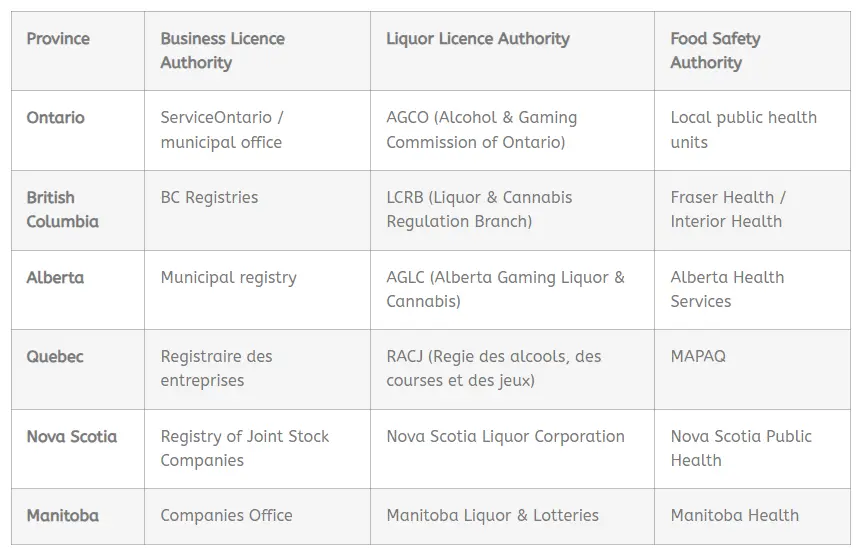
Each province has its own fee schedules & application portals. Visit the relevant authority website directly for current processing times & costs.
11. Frequently Asked Questions
Q: Do I need a licence to play music in my restaurant?
A: Yes. Under Canadian copyright law, playing music in a commercial space like a restaurant requires a licence even if you use a personal streaming service like Spotify. You need to register with both SOCAN & Re:Sound. Both can be done online. Fees start at around $200 per year & go up based on venue size & type of music.
Q: What is the difference between a licensed & unlicensed restaurant in Canada?
A: A licensed restaurant holds a liquor licence from the provincial authority & can legally sell & serve alcohol. An unlicensed restaurant can serve food but cannot sell alcohol. In some provinces unlicensed restaurants can offer BYO under a separate endorsement. Licensing status has a direct impact on revenue, lease terms & how your business appears on review platforms.
Q: How long does it take to get all the licences needed to open a restaurant in Canada?
A: The full licensing process typically takes 3 to 6 months when you factor in all the permits. The business licence can be sorted in a few days. The health inspection usually takes 2 to 4 weeks. The liquor licence is the longest & can take 8 to 16 weeks or more depending on the province. The key is to start all applications as early as possible & run them in parallel, not one at a time.
12. Wrapping Up
Getting your restaurant licences & permits sorted is not the most glamorous part of opening a restaurant but it is one of the most important. Miss a licence & you risk fines, delays or having to shut down before you even get going.
The key takeaways are simple. Start early, especially on the liquor licence. Budget for $500 to $5,000+ in year one across all your permits. Check your local municipal & provincial authority websites for current fees & processing times. Run all applications in parallel where possible.
Once the legal side is covered, the fun part begins. If you want to hit the ground running from day one, Foodship gives Canadian restaurant & cafe owners everything they need in one place — online ordering, a restaurant POS system & your own restaurant website, all built for how Canadians order food today.